
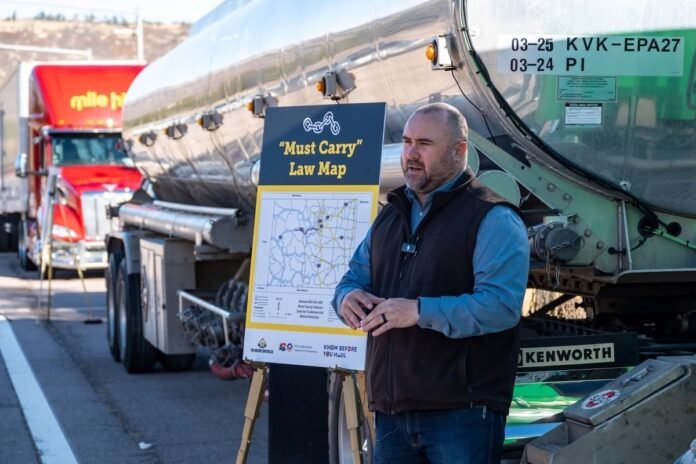
Truck drivers traveling through Colorado should be aware of the requirements regarding chains for commercial vehicles, which will take effect in early September.
Each year, from September 1 through May 31, commercial vehicle drivers are required to carry chains or approved alternative traction devices (ATDs) when traveling on the following roads:
- I-70 west of mile marker 259 (Morrison) to the Utah state line
- Colorado Highway 9, from mile marker 63 to mile marker 97 (from Frisco to Fairplay)
- Route 40, from mile marker 256 (Empire) to the Utah state line
- U.S. Route 50, from mile marker 225 (Salida) to the Utah state line
- U.S. Highway 160, from mile marker 304 (Walsenburg) to the New Mexico border
- U.S. Highway 285, from Mile Marker 250 (Morrison) to the New Mexico border
- The entire length of U.S. Highway 550
Colorado’s requirements for the use of snow chains on commercial vehicles apply to vehicles with a gross combination weight exceeding 16,000 pounds that are used for commercial purposes or to transport at least 16 passengers (including the driver) on public roads.
See below for fines for violating Colorado’s snow chain law:
- Over $50 for failing to use snow chains
- Over $500 for failing to install chains
- Over $1,000 for obstructing traffic by failing to install chains
Snow chains are required starting in September, as winter weather conditions can set in early in the state’s mountainous regions.
The Colorado State Patrol typically conducts checks during the fall and winter months to ensure that drivers are carrying the required snow chains.
The Colorado Department of Transportation (CDOT) uses electronic signage, radio channels, the official CDOT traffic information website (cotrip.org), a telephone message system, email, text messages, and other automated personal notification systems to alert drivers when tire chain restrictions are in effect.
See below for details on the number of tires that must have chains for each type of vehicle.
Vehicles required to have chains on all four drive wheels:
- Rigid trucks: 4 tire chains, 4 AutoSocks, a combination of 2 tire chains and 2 tire cables with a diameter of 0.415 inches or greater, automatic chains, or sand spreaders.
- Combinations with a single drive axle: 4 tire chains, 4 AutoSocks, car chains, or sand spreaders. Cables are not permitted.
- Tandem drive axle combinations: 4 tire chains, 4 AutoSocks, cables for tires with a diameter of 0.415 inches or more, car chains, or sand spreaders. Tire chains are permitted only if the outer tires on both ends of a drive axle are equipped with tire chains and at least four traction devices are used in total.
- Vehicle transporters: 4 tire chains, 4 AutoSocks, 4 tire cables of 0.415 inches or more in diameter, car chains, or sand spreaders. Do not use tire chains if their use risks damaging hydraulic lines (alternative traction devices (ATDs) may be used to mitigate the risk). Operation will be restricted if the vehicle cannot be equipped with tire chains.
Vehicles required to equip both drive wheels with chains:
Urgent transport: Traditional motor vehicles (such as pickup trucks) that tow a trailer and meet the weight criteria mentioned above must also be equipped with tire chains. Two tire chains are required for single-axle vehicles (to be placed on the rear tires). Exception: Dual-axle vehicles require four tire chains.
Buses: 2 tire chains, 2 tire cables with a diameter of 0.415 or greater, 2 AutoSocks, car chains, or sand spreaders.